ZMB Building
One contractor, full responsibility.
In construction, the client isn't buying a service — they're taking on risk. Everyone has heard the story of the slipping deadline, the subcontractor who appears and vanishes, the half-year of scaffolding in front of a half-finished house. For a general contractor, the real job of a website is to dissolve that fear.
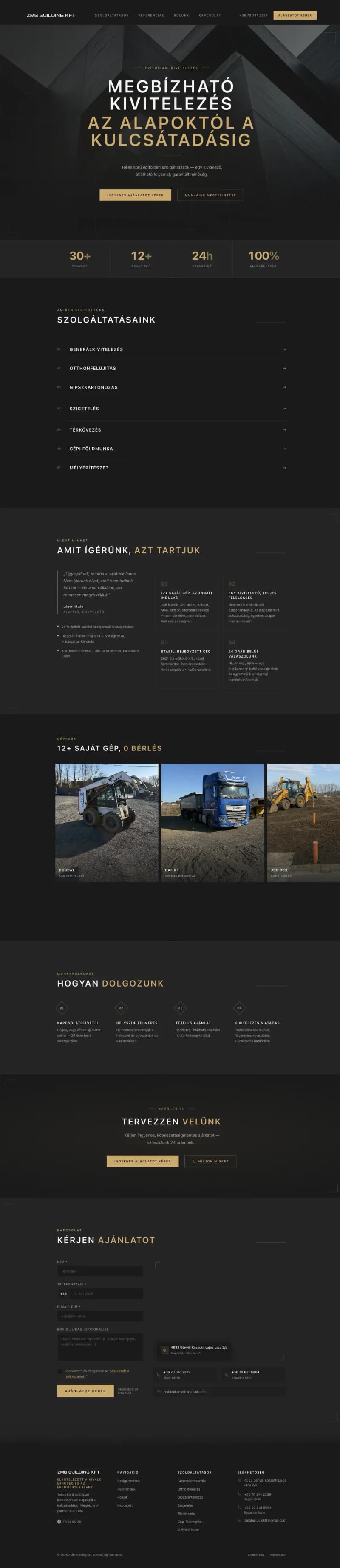
ZMB Building is an Eastern Hungarian general contractor operating since 2021, whose promise fits in one line: one contractor, full responsibility, from the foundation to the handover. The site had to make that reliability felt in the first second.
Not the usual construction template
Sites in this trade are typically blue-and-white, stock-photo, "every house is the same" templates. ZMB went the opposite way: a dark, near-charcoal base, a single warm gold-sand accent on the highlights, and high-contrast, confident typography. The sections are numbered (01–07) with monospace ordinals — a structured, engineered rhythm that signals reliability on its own.
The images are the most important decision. Real photos shot on site: concrete elements, the company's own machines in the trench, sand. For a construction firm, credibility is shown by its own work, not by a purchased render.

The content that builds trust
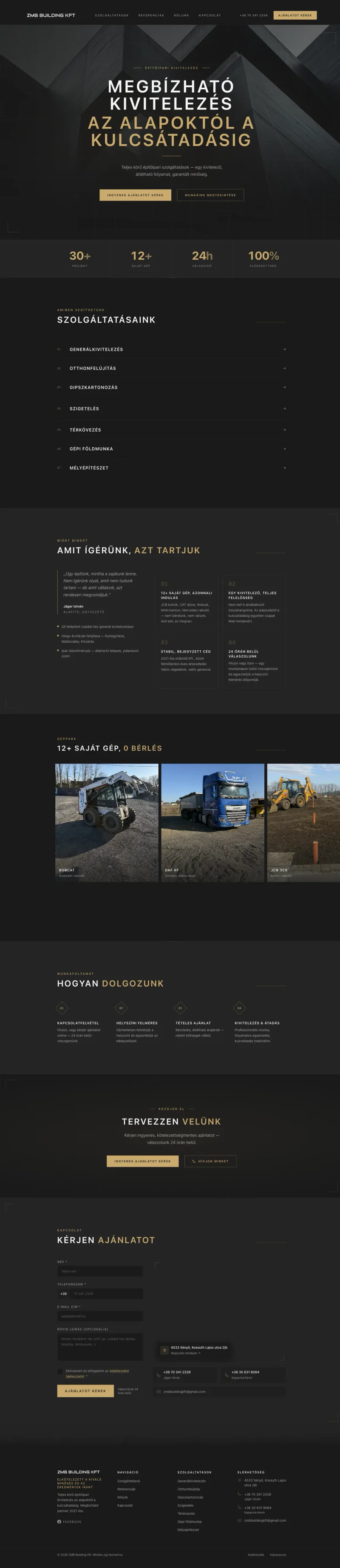
Trust is assembled from specifics, not adjectives. The spine of the site is therefore proof: a founder's quote that states the attitude; a fleet section that backs the "own machines, not rented" message with a scrollable gallery of equipment; and a four-step workflow (contact, on-site survey, itemized quote, build and handover) that shows in advance what will happen. Someone who knows what comes next is less afraid.
Each of the seven services — from general contracting to earthmoving — got its own subpage, so a client curious about the details finds their case, while the home page stays uncluttered.
What's under the surface
The whole thing is tuned for one goal: the free, no-obligation request for a quote. The contact form runs server-side, with a hidden honeypot field against spam and a required data-handling consent. The map loads only after consent, alongside the cookie bar — clean data handling is due even on a brochure site. The framework is Next.js, the images are WebP, optimized for mobile, because most clients arrive from a phone.
There's always a next level.
If you like what you see (whether you're building a product or a team) I'd love to hear about it.